

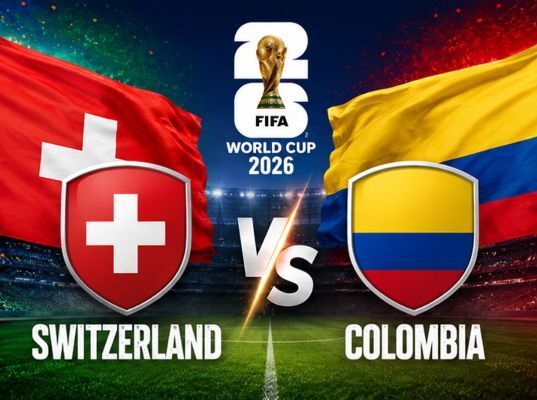
How Switzerland approaches the match
I like the way Switzerland have grown in this tournament. They have scored 9 goals, produced 8.5 xG, averaged 58 percent possession and 89 percent passing accuracy, and they now look more vertical than many Swiss teams of the recent past. Johan Manzambi has changed the rhythm of this side with 3 goals and 2 assists, while Embolo brings the sort of centre-forward play that pins centre-backs and opens lanes for runners. Vargas and Ndoye have also contributed, which makes the attack less predictable.
Still, I do not see a flawless team. Switzerland have only one clean sheet, and even Algeria generated 0.73 xG. Their aggressive shape can leave space, especially if the left side pushes too high. Against Colombia, those spaces are dangerous. The good news for Murat Yakin is the emotional burden is lighter now after that first knockout win in 88 years. The possible concern is Ruben Vargas, who is listed as questionable, while Fabian Rieder and Noah Okafor have injury concerns. I expect Switzerland to start fast, press early, and try to turn travel freshness into territorial pressure.
How Colombia approaches the match
Colombia look like the more controlled side. One goal conceded in four matches, three clean sheets, 62 percent possession, 90 percent pass accuracy, 52 chances created, and a brutally tidy 1-0 win over Ghana where they allowed no shots on target and just 0.26 xG. That is not noise, that is structure.
Luis Diaz is the main direct threat, James Rodriguez is still the game’s chief locksmith, and Jhon Arias plus Daniel Munoz give Colombia width, timing, and late runs. I also rate their defensive spine highly, with Camilo Vargas behind Davinson Sanchez and Lucumi, plus Lerma screening. The slight issue is attacking efficiency. Colombia have 5 goals from 5.9 xG, so they have not always buried games when on top. Jhon Cordoba is also listed out with a groin injury, which can reduce their physical presence up front. Even so, this team is built for knockout football and looks ready for a long night.
What happens if the match is tied after 90 minutes
If the score is level, we get two extra periods of 15 minutes. If that still does not separate them, the tie goes to penalties. In that scenario, squad depth, recovery, and emotional control become everything. Switzerland may benefit from fresher legs because they stayed in Vancouver while Colombia had to travel from Kansas City. Colombia, though, have the calmer defensive structure and a goalkeeper in Camilo Vargas who has lived through low-margin games in this tournament. I would also trust James, Diaz, and Arias as penalty options, while Switzerland have experienced leaders like Xhaka and Embolo for those moments.
Match prediction and the team that will advance
I expect a tight match with changing phases. Switzerland should start with more aggression, but Colombia are better equipped to punish open grass and protect a lead. My regular-time probabilities are close to 29 percent for Switzerland, 30 percent for the draw, and 41 percent for Colombia. That makes the main value play Both Teams To Score, Yes at 1.91, because Switzerland have too much attacking form to dismiss, while Colombia’s wide transitions can hurt a team that presses. The alternative is Colombia draw no bet if the price is fair.
My probable score after 90 minutes is 1-1. The probability of extra time feels high, around one in three. For the market on qualification, I lean Colombia to advance. The 2.20 on the 90-minute win reflects their stronger defensive profile, but my real preference is Colombia over the full tie, because this looks like a game where their discipline can outlast Switzerland even if regular time ends level.